
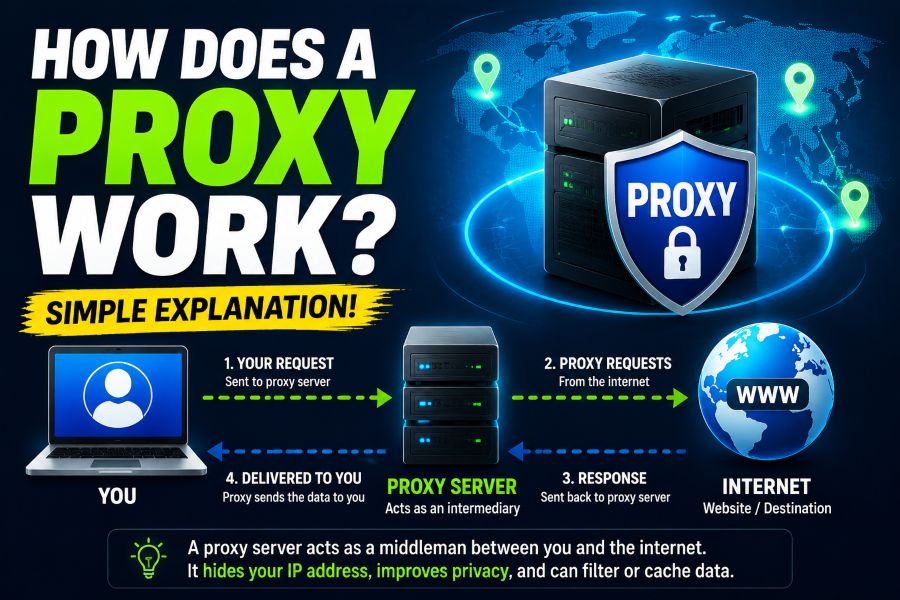
Understanding how proxy work starts with a simple idea: a proxy server stands between your device and the website or online service you want to reach. Instead of connecting directly, your request goes through the proxy first.
The proxy then forwards that request using its own IP address. When the website responds, the proxy sends the data back to you. This extra step can affect privacy, access, speed, filtering, and security.
People use proxies for many reasons, from managing business traffic to testing websites in different locations. They are also used in schools, offices, apps, and networks where administrators need more control.
A proxy is not magic, and it does not make every online activity invisible. But when used correctly, it can be a practical tool for routing internet traffic in a more controlled way.
A proxy works like a messenger for internet requests. Your browser or application sends data to the proxy, and the proxy decides where that data should go next.
Because the destination website sees the proxy address, your original IP address is not exposed in the same direct way. This can help separate your device from the websites you visit.
Different proxies handle different kinds of traffic. Some are built for web browsing, while others support apps, automation tools, streaming, or internal company systems.
Proxies can also apply rules before traffic reaches the open internet. A business may block certain websites, scan requests, cache repeated content, or monitor usage patterns.
The final result depends on the proxy type, configuration, and provider quality. A fast, trusted proxy can improve control, while a poor one can create privacy, security, or performance problems.
What Happens When a Proxy Handles Traffic?
Your Device Sends a Request
The process begins when your browser, app, or system asks to load a website, file, or online service. Instead of sending that request straight to the destination, the device sends it to the proxy server configured in the network or application settings.
The Proxy Receives the Data
The proxy accepts the request and reads the basic routing information needed to process it. Depending on the setup, it may inspect headers, apply access rules, check authentication, or decide whether the request should be allowed.
The Proxy Forwards the Request
After processing the request, the proxy sends it onward to the target website or service. At this stage, the destination usually sees the proxy IP address rather than the original IP address of the user device.
The Website Sends a Response
The website responds to the proxy as if the proxy were the visitor. It sends back the requested page, image, file, or data packet, and the proxy becomes responsible for delivering that response to the original user.
The Proxy Returns the Result
Once the proxy receives the response, it passes the content back to your device. In many cases, the user experience feels nearly identical to direct browsing, although speed can vary based on distance, server load, and proxy quality.
Rules May Be Applied
A proxy can do more than forward traffic. It may block restricted websites, cache popular resources, log activity, rotate IP addresses, filter harmful content, or route traffic through a specific geographic region.
The Connection Ends or Repeats
After the requested data is delivered, the connection may close or remain active for additional requests. Modern browsing creates many small requests, so a proxy often repeats this process many times during a single website visit.
Key Reasons People Use Proxies
1. People use proxies to mask their original IP address from websites and online services.
2. Businesses use proxies to control employee access, monitor traffic, and enforce network policies.
3. Developers use proxies to test how websites and applications behave from different locations.
4. Companies use proxies to collect public web data while distributing requests across multiple IP addresses.
5. Network administrators use proxies to cache content, reduce repeated bandwidth use, and improve traffic management.
Common Proxy Types Explained
- Forward proxy: This proxy sits in front of users and sends their requests to the internet, often for privacy, filtering, or access control.
- Reverse proxy: This proxy sits in front of servers and manages incoming visitor traffic, often improving security, load balancing, and performance.
- HTTP proxy: This type handles standard web traffic and is commonly used for browsing, content filtering, and basic request routing.
- HTTPS proxy: This proxy supports encrypted web connections and can help route secure browsing traffic when configured correctly.
- SOCKS proxy: This flexible proxy works with many traffic types, including browsers, apps, messaging tools, and some peer-to-peer services.
- Residential proxy: This proxy uses IP addresses associated with real residential networks, which can make traffic appear closer to normal consumer browsing.
- Datacenter proxy: This proxy uses IP addresses from server infrastructure and is often faster and cheaper, but easier for websites to identify.
Proxy Benefits and Limits to Know
Privacy Is Limited
A proxy can hide your IP address from the destination website, but it does not automatically make you anonymous. The proxy provider may still see your traffic metadata, and websites can use cookies, browser fingerprints, and login details to identify users.
Security Depends on Trust
A proxy becomes an important middle point in your connection, so trust matters. Free or unknown proxy services may log activity, inject ads, slow traffic, or expose users to unnecessary risk if they are poorly maintained.
Speed Can Improve or Drop
Some proxies improve performance by caching repeated content or routing traffic efficiently. Others slow browsing because they are overloaded, far away, misconfigured, or using low-quality infrastructure.
Location Control Has Practical Uses
A proxy can route traffic through a chosen city, region, or country. This is useful for ad verification, search result testing, localization checks, market research, and confirming whether content appears correctly in different places.
Authentication Adds Control
Many private proxies require a username, password, IP whitelist, or token. Authentication helps prevent unauthorized use and gives businesses better control over who can send traffic through the proxy.
Proxies Differ from VPNs
A proxy usually works at the application or protocol level, while a VPN often routes most device traffic through an encrypted tunnel. Proxies are often better for targeted tasks, while VPNs are usually simpler for full-device privacy.
Legal Use Still Matters
Using a proxy does not remove responsibility for online behavior. Users should respect website terms, privacy laws, copyright rules, and data access restrictions, especially when proxies are used for automation or web data collection.
A proxy works by receiving your internet request, forwarding it to the destination, and returning the response to your device. That simple routing role can support privacy, access control, testing, filtering, and traffic management.
The most important thing to remember is that proxies vary widely. A business-grade proxy, a free public proxy, a residential proxy, and a reverse proxy can all serve very different purposes.
Before choosing one, define the task clearly. Decide whether you need location control, security, speed, filtering, automation support, or server protection.
When you understand how proxy work in real situations, it becomes easier to choose the right type and avoid assuming that every proxy offers the same level of privacy or reliability.
FAQs About how proxy work
What is a proxy in simple terms?
A proxy is a server that acts as an intermediary between your device and the internet. It receives your request, sends it to the destination website, and then returns the response to you.
Does a proxy hide my IP address?
Yes, a proxy can hide your original IP address from the website you visit by showing the proxy IP address instead. However, that does not guarantee complete anonymity.
Is a proxy the same as a VPN?
No, a proxy and a VPN are different. A proxy usually handles traffic for a specific app or protocol, while a VPN commonly routes most device traffic through an encrypted connection.
Can proxies make browsing faster?
Sometimes proxies can make browsing faster by caching repeated content or improving traffic routing. They can also slow browsing if the proxy server is overloaded, distant, or low quality.
Are free proxies safe to use?
Free proxies can be risky because some may log activity, inject ads, expose data, or provide unstable connections. For sensitive tasks, a trusted paid provider is usually safer.
Why do companies use proxies?
Companies use proxies to manage access, monitor traffic, protect internal systems, test web services, verify ads, collect public data, and improve network control.
Can a website detect proxy traffic?
Yes, websites can sometimes detect proxy traffic by checking IP reputation, request patterns, headers, location mismatches, and browser fingerprint signals.